Wednesday, August 3, 2011

How Channeling the Likes Of MTM Hit The Runway

Here's a funny little recollection. Along with the likes of MTM inadvertently, I inspired one very unassuming Helmut Lang runway look for Fall 2003. I worked for Helmut Lang from 2002-2004, right before he left the fashion world (and his label) to work full-time as an artist. My job was easy and low-maintenance, so combined with the minimal aesthetic of the brand, the experience was monastic. This fulfilled my (strange?) childhood dream of becoming a monk...! 

I was working at Helmut Lang's pet project, a perfumerie shop (with incredibly clean fragrances that are still a favorite of mine) in Soho. The shop resembled an apothecary-type lab and it also housed an art installation. It was extremely white and pristine and people seemed generally intimated by the place. Those who dropped in the most seemed to be celebrities who loved his clothes. My job was to stay there all day and represent the brand. So there I would wait, listening to French radio (Radio Nova) or the selection of music that fit the mood of the label. Several times, I helped the PR and marketing departments that lived across the street, but in general, that was it. Overall, I really enjoyed my solitary time there.

I interacted with Helmut Lang several times - which required very few words, as he is indeed a quiet man. I remember the first time he came in when I worked there. This was towards the end of 2002, and he seemed to be intrigued by how I had worn his clothes. He took a very long look at what I was wearing. My work wardrobe at that time consisted of some fitted, dark gray sweaters - one with a v-neck and buttons and one with a round neck - beautifully cut black pants, some white button down shirts and a few other items, including great shoes. 

These items were worn in rotation, but somehow I seemed to be the only female who paired the white button down under the round neck sweater, sometimes with the shirt poking out from the bottom. It was a preppier, even girlier version of how the other people at the company wore the clothes. As it happened, I was just channeling what always personally inspired me, an assortment of looks from Francoise Hardy, "Two For The Road", "Love Story", Jane Birkin and "The Mary Tyler Moore Show". These were my daily style inspirations and I wore whatever items of clothing I had in that way. 

Here are the ladies in my frame of reference at the time (and still):


But again, this was 2002. At that time, this rather conservative preppy late-60's/early-70's aesthetic was not the norm. Although with plenty of incarnations since, it does look very normal today. In 2002, the style norm was extremely different... or dare I say it, rather dodgy looking. Women were wearing low-cut jeans and belly-baring tops, and tended to be inspired by the mainstream hip-hop-dancing pop stars of the day (if you don't remember, it's an easy search.) Those were styles I never registered or considered wearing... they even failed to cross my line of sight, since I lived in a fairly tight retro bubble

In that context, it isn't surprising that one quiet, minimalistic and forward-thinking designer (and as I noticed, on several occasions, famous high fashion models staring at my version of "street wear" with some level of fascination) should pause and notice how I was wearing his own clothing differently than he'd anticipated. Soon after that first visit, one of his head designers also stopped by at the store, which never happened before or since. We smiled a lot and made chit-chat, but he didn't seem to have much reason to have dropped by. Then, some time later... ta-da! When the photos from the Helmut Lang Fall 2003 runway show were released, my coworker and I were staring at the images and both gasped at what Natalia Vodianova was given to wear on the runway. The look was me, incarnate. 

Given how I was in the designer's line of sight and it was so incredibly easy for them to just pair those pieces together, it made perfect sense. But it managed to look interesting at the time and really stood out from the rest of the show. What's most fitting is that any influence I had was so unintentional. And where else would that sort of simple (but definitive) point of view have been recognized, if not through the eyes of such a quiet and observant designer? 

That is a nice memory I was able to take away with me, along with some fabulous pieces I still wear. For fun, I recently checked Style.com for a review of that particular show. Especially amusing (and so great) is how such a very simple look was singled out in the review... which goes to show how surprising it happened to be in 2002. Little did Helmut Lang himself realize he was inadvertently inspired by the likes of Mary Tyler Moore... ;-) 

Here's the excerpt from the review posted on Style.com for Helmut Lang's Fall 2003 show: "He certainly hasn’t abandoned his minimalism-with-a-gorgeous-kick: when he sent out Natalia Vodianova wearing a men’s shirt, skinny sweater and plain short skirt... his fans all but fainted." (Fainted?!)

Wednesday, June 29, 2011

Summer Lovers (1982)

Chances are you haven't seen the film 'Summer Lovers'––but it's more than likely you'd enjoy aspects of it, if you did. This is a surprisingly good movie with fine elements. The best part of watching the film is you'll feel like you've taken a mini-vacation to Greece. The cinematography is unexpectedly lush, the setting is gorgeous––and the actors are as easy on the eyes as the location.
The sight of Daryl Hannah and Peter Gallagher, looking young and in love, looks eerily reminiscent of Hannah's real-life romance with John F. Kennedy, Jr. in the 80's. I found myself particularly partial to Daryl Hannah's sporty, preppy casual vacation wardrobe.

The story involves a ménage à trois between the couple and a lovely French woman (Valerie Quennessen) who is an archeologist staying nearby the vacationing couple. Well, it isn't exactly a ménage à trois––it's more like Peter Gallagher with two ladies. I suppose it's a male fantasy. The women are not as involved with each other as they are with him. The threesome becomes a type of family unit as they spend more and more time together.
'Summer Lovers' is a harmless movie, and in many ways it's very enjoyable. I live in San Francisco, so I enjoy watching films that provide a warm, vacation-like atmosphere. The typically cold and foggy climate here can leave much to be desired in the summer.
One dubious element that pops up is when Daryl Hannah's character's mother turns up, out of nowhere (with her best friend in tow) to 'surprise' her daughter and boyfriend during their vacation. The only purpose for that to happen within the story is to have someone outside of the three principal characters' experience show their react to it. A mild reaction, nonetheless –– so it's altogether a fairly useless plot point.
One amusing element is the ending. I did not expect to see a 'sad' montage to Chicago's 'Hard To Say I'm Sorry' suddenly rear its head; there is no prior indication that it could happen based on the music that precedes it. The couple has lost their girlfriend, who has decided to stay away because it's too difficult to say goodbye to them. But then it becomes a happy ending, as the threesome stays on –– together in Greece. Hurray! It all makes for light and pleasant entertainment from the summer of 1982. A perfect getaway.
Enjoy the trailer!

Thursday, June 9, 2011

Video Surprise––You'll Never Guess Who This Girl Is, 'Captain of Her Heart' Video; 1986 (Denise Richards, Or Still A Mystery?)

These photos are screen shots of a young woman who appears in the video for the song 'Captain of Her Heart'  (by the Swiss group, Double) from 1986. A while ago, I used some footage from that video for one I made to go with Spandau Ballet's 'Gold'. And this tremendously chic punk girl appears at the very beginning.
So here's the surprise. I have a knack for recognizing faces and I still would never have guessed this one, it is so tricky and utterly shocking. Lo and behold, who was this bleached blond beauty? Supposedly, and there is not a shred of photographic evidence otherwise, this is Denise Richards. Of course, this is according to Wikipedia (on both Denise Richards' page and Double's page.) But it has never been confirmed.
(Supposedly) Denise Richards
If this is not Denise Richards, how did this rumor even begin? If this is her, she would have been 15 years old here.
(Could be) Denise Richards
(Might be) Denise Richards in Double's 'Captain Of Her Heart' video
Here is the elegant but cheesy video featuring a bevy of beauties. The lovely young woman who is supposedly Denise Richards appears at 0:30. Note the stunningly gorgeous gray-haired lady at 1:10.

Wednesday, June 8, 2011

Surprising Video Element –– Belinda Carlisle's 'Mad About You' (1986)

Belinda Carlisle's song 'Mad About You' is an 80's summer classic, and I discovered recently that the video for the hit song has a certain life of its own that lends well to the song's ultra romantic feel.
It's been well-documented in interviews, and in her memoir 'Lips Unsealed', that Belinda Carlisle has had her share of obsessive-compulsive addictions –– from drugs, to food, and any other number of dangerous leanings. Back when she led the Go-Go's to super stardom, the press was terribly unkind to the lovely Belinda about her weight. Although she is a phenomenally gorgeous woman, no matter what, she understandably felt disenchanted by the Hollywood image roller-coaster into which she was firmly planted. 
Carlisle has stated in interviews that when she made the video for 'Mad About You', she celebrated a newly slim, mature appearance. She's explained that she had never felt so beautiful before. This was right after she had kicked her massive addiction to cocaine for the first time. But the most interesting (and romantic) thing about the video is that it features her husband, Morgan Mason, son of the great actor James Mason. Carlisle and Mason were newly married and she attributes her desire to clean up her act to his love and support.
So when you see this video within that context and frame of reference, it takes on a whole new meaning. She says, 'I'm mad about you, you're mad about me, babe...' and it is clear how much they are in love. 
There is a sense of newfound freedom in it, evidence that he loves her unconditionally, whatever her weaknesses or frailties and that together they've created a solid foundation for their future. It is also charming that they seemed to have been such very different personalities –– he being the more subdued and quiet of the two, Belinda Carlisle clearly the wild-child rock star learning to grow up.
And they are still married, incidentally. It's always fun to discover a romantic story like that. See the video for yourself, below.

Sam Fuller's 'White Dog' (1982)


'White Dog' was Sam Fuller's final film, and it was terribly misunderstood at the time of its release. Although the film did quite well in Europe, especially in France, it wasn't given an adequate reception here in the U.S. Groups like the NAACP mistook its very anti-racism meaning for something aligned with racism itself. Which was most unfortunate, since Sam Fuller was known for being a great champion of civil rights. Must have been difficult for Fuller to see his last (and arguably greatest) film be profoundly misinterpreted.


Now that the Criterion Collection gave 'White Dog' a proper DVD release, niche audiences are finally able to embrace Fuller's captivating movie. The film deals with racism in a touching way, through the eyes of an innocent dog found and adopted by a young woman, who then discovers her dog had previously been trained to hate black people. Needless to say, 'White Dog' went into my Netflix queue, and I anticipated seeing this unusual movie. 

The character of Keys attempts to cure the dog
There are now many positive reviews and blog posts dedicated to this touching movie. What I can add is that this movie is (still) not for everyone. It has a distinctively early-80s feel, which I love about it, and the direction in some ways reminded me of the great DePalma films of the 1970s. 

'White Dog' is very filmic and beautiful, and the story is immensely moving because there is an urgency to it. You hope beyond hope that this dog can be cured of his terrible, human-imposed affliction. But you know things will probably end badly for the poor, innocent creature. 

Anyone who loves animals –– as these characters do, as well –– will feel tremendous sadness and empathy for the dog. I have never seen a performance by a dog (there were several white dogs acting in the role) that was this intense and realistic. I don't believe it is respectful, or responsible, to use non-human animals in films and television, or for any  form of human entertainment. Nevertheless, the dog's performance here is truly astounding.
This dog gives a powerful performance
Another fascinating insight into 'White Dog' is that it is based on Romain Gary's novel, 'Chien Blanc', which was originally published as a short story in 1970. 
Romain Gary with his wife, Jean Seberg
Incredibly, the story was inspired by real-life events. Romain Gary was married to the actress Jean Seberg at one time. (Both tragically committed suicide years later; Gary, within a year of Seberg.)
Jean Seberg, Romain Gary
He and Seberg actually found and adopted a 'white dog', not realizing at the time that the dog had been trained to attack black people. They were shocked and dismayed at the terrible discovery. And from there, the story was born. 
Romain Gary was friends with Sam Fuller, and when the story was to be adapted to film, Sam Fuller and Curtis Hanson wrote the screenplay together. 'White Dog' was indeed a collaboration of the highest order, and it still is. 'White Dog''s lavish and sadly delayed acclaim would have made all of those involved –– Sam Fuller, in particular –– glad for their well-intentioned efforts.  
Kristy McNichol as the actress who finds and hopes to save the dog
Here are two clips from the movie. The first is a touching moment between the dog and his newfound adopter. 
The second clip features a wonderfully earnest performance by Kristy McNichol when she encounters the abominable racist responsible for training her ill-fated white dog. (What follows the clip is a fan video which incorporates an oddly upbeat song.)

Thursday, May 19, 2011

Musical Impact - 'Veronica' by Elvis Costello

Sometimes the magic of a truly exceptional song hits you when you least expect it. This happened to me recently with Elvis Costello's 'Veronica', a song I'd loved when I first heard it. It came on the other day on a Pandora station I was listening to while out in public, so it was an inopportune time for me to get extremely emotional. I was surrounded by people and almost had to run away, since I was in tears, but I kept my composure as well as I could while listening to the song through my headphones. I was then struck by how incredibly effective a song can be in stirring emotions you never knew were there. When that song is a legitimately great one. Elvis Costello's 'Veronica' is co-written by Paul McCartney, who also plays bass on the track, and the song is co-produced by T-Bone Burnett. It's a beautiful, emotion-filled, catchy tune. A perfect pop song. 


But Elvis Costello wrote this song for his grandmother, 'Veronica', and it depicts so movingly, with the greatest artistry and such intricate lyrics, his experience in watching her struggle with Alzheimer's disease. Although I'm not witnessing this experience as he did, since my grandmother is geographically far away from me, I now have a grandmother like 'Veronica' too. Despite my infinite number of questions to my mom (who has been witness to the way the disease has affected my grandmother) about this confusing experience, my emotions about it were somehow locked away. 

I thought this song was beautiful before. But now it has touched on new feelings in me, because of an awareness of this disease that has affected my family. They are feelings I could not have grasped until now. Elvis Costello, with this one lovely song, made me understand with great intensity what we're dealing with here. It's something very mysterious to which any wonderful person, so full of life and experience named 'Veronica', someone who could be anyone's grandmother or grandfather', can sadly fall victim. 


This is the sort of music I will always treasure. There's so much more I could say about it, but I am grateful for Elvis Costello for giving me that good cry I seemed to need–––and for doing his best to clarifying for others what happens to be a very confusing experience. We all know that there is so much more to our own Veronicas than what we are left with.


I'll leave you with the beautifully poignant song here.

Wednesday, May 18, 2011

Julie Christie in 'Darling' is anything but... (1965)

'Darling' has been an interesting film for me to experience over time. When I first watched it, years ago, I felt as if it were my duty as a fan of the 'Swinging Sixties' era to see it. I was initially curious about the film since Julie Christie had (deservedly) won the Best Actress Oscar for it in 1965. This was the breakthrough performance that made her a bona fide English star. John Schlesinger directed it, so it had to have some depth. But I wondered at the time what it all meant. I wondered what the point of it was. 
After watching it again recently, whatever I hadn't grasped before was abundantly clear. The character of Diana Scott in 'Darling' is anything but what the title suggests. The film manages to show us there are Diana Scotts, of varying degrees, in our world - both then and now. Diana is someone whose only talent lies in getting whatever she wants. 
She admits to it early on as she describes her life - that even as a child, she was always someone who was picked for things. She is incredibly self-centered and opportunistic. There is absolutely no meaning in her life other than to get satisfaction in some way. Every moment of her existence and in every experience she has with other people is reduced - by her - to simply being about her. Every relationship she has must service her own needs. Not once in the entire journey we take with Diana Scott does she think about someone else's feelings. She is, in fact, one of the most deplorable, selfish and unattractive female characters in the history of films. 
Julie Christie plays Diana Scott with a very believable but chillingly singular beat. She may have varying emotions, but she maintains the same rhythm no matter what the situation. 'I, me, mine' is her mantra. It is understandable that decent people can be taken with her, since she has a childlike charm and innocence. But there are moments when it's staggeringly evident that Diana Scott is nothing short of a monster. 
Diana Scott's journey is one that allows her to go from London housewife, to mistress, to famous actress, to a European princess. Perhaps all of the visions or hopes that any attractive woman might have ever had for herself, Diana Scott manages to experience in her lifetime. Yet she is never grateful and she is never happy. Even she doesn't seem to realize it, as she alters much about herself when she retells her story in voiceover for a magazine article. And at the end of the film, despite her every questionable act or behavior, no one in the public is even aware how void of humanity this woman is when they see her photo on the cover of a magazine and pick up a copy. To the outside world she has lived a charmed life and she is darling. It's chilling to think how many successful (or simply famous) people today might fit that very description. Now I see where Schlesinger was going with this. 'Darling' speaks volumes about people who incessantly seek attention, validation or power. This vehicle we're seeing might be a thing of beauty, but it is void of humanity... and therefore leads a sad existence.

Friday, April 15, 2011

80's Obscure - When Music Videos Had Impact, Featuring Bronksi Beat's 'Smalltown Boy' & Toto's 'Africa'

A still from 'Smalltown Boy' by Bronski Beat
'No, you never cried to them, just to your soul...'

The first time I saw 'Smalltown Boy' is an experience I'll never forget because it made me cry. I felt enormous empathy for the protagonist and really didn't know why. I was young and I didn't actually know what it meant for someone to be gay. I only saw that he was terribly alienated and it seemed so real and incredibly sad that it tore me up. 

The song itself is very moving, even without any visual representation - but this was the first time I realized a music video can have great emotional impact. In fact, there is more power and gravitas in the video for 'Smalltown Boy' than in an alarming number of feature-length films. Another video that attempts a similar storytelling angle is Pat Benatar's 'Love Is A Battlefield', but hers is over-the-top and unintentionally kitschy. "Smalltown Boy' manages to tell one of the most poignant stories I've ever seen in just five minutes. I still get terribly choked up when I watch it now. Given the recent, long-overdue attention to the issue of bullying, it also feels quite current.

Watch it for yourself here...
But 80's videos that have an impact are not necessarily sad ones. For the most part, they have simple but unique visual qualities that are no longer present in music videos.
A still from 'Africa' by Toto
Toto's video for 'Africa' is not as emotionally moving but its impact lies in a unique aesthetic quality that makes for a satisfying experience. This video made me want to travel to 'Africa' and it just feels warm and inviting somehow. Again, that is a great visual representation of how the song, itself, sounds and feels - which lends to its cohesion. It appears they didn't have much to work with (and were on a tight budget) but they still managed to create the right feeling. 

Check out 'Africa' below...

Thursday, April 7, 2011

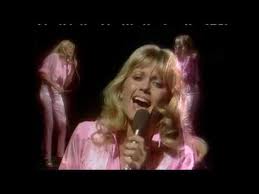
Olivia Newton-John in 1978 (Totally Hot Tour)

In 1978, fresh off her iconic turn as Sandy, the goody-goody who becomes hot in 'Grease', with the tight black spandex-clad vision of the blond beauty fresh in people's minds, Olivia Newton-John capitalized on Sandy's transformation with one of her own. She embarked on her Totally Hot Tour to support her album (aptly named 'Totally Hot' of course.)
Before 'Grease', ONJ was essentially a wholesome country singer - albeit an Aussie one - who typified a squeaky clean image. What came after 'Grease' was an exploration of the theme of her own transformation into a sparkling, shining vixen. This period of ONJ's career could have been called 'Totally Pink'... because she wore a lot of it. (In these tour photos, her outfit looks lavender - but it was actually very pink.) She still maintained her clean image, whatever she did and wore. Because despite any effort to play up a sexy image, who she is within shines through and takes that to another level of a more goddess-like appeal. Not many people can rock pink spandex with a sparkly pink top and look like an exquisite Barbie doll (in the most authentic sense.) Of course, many have tried and failed. 

As a side, and jumping forward a few years to her heyday in the 80's, my first recollection of seeing Olivia Newton-John was when she performed her song 'Make A Move On Me' on a Solid Gold. That image of her bounding around the stage with her high-watt smile in a pirate outfit (her pirate stint was short-lived, but memorable) recalls for me the first moment in my childhood when I thought, 'That's something I might want to do...!' This appearance found itself an indelible place within my psyche and I never forgot it. Incredibly, someone uploaded that performance on YouTube, so here it is...
I did perform quite a lot in my youth, on stage in some instances. And as an adult, it turned out I could sing in a 'pure soprano' according to a seasoned Broadway coach who insisted on hearing me do scales (I was inadvertently watching his class.) I can sing any of her songs on key and even auditioned to play Sandy once in New York... and made it through a couple of rounds. Although being a performer was not what I wanted to pursue, a (brunette) ONJ is the closest thing to what I might have become, had I chosen to make it my life's work and was touched by some level of fate to do so. Despite any number of differences, our birthdays happen to be very close and we have similar dispositions. 
So when I watch an ONJ performance circa 1978, I marvel at what it might have been like to be her - at that specific point in time, just before she 'peaked' - while being acutely aware there's never been anyone quite like her since.

Sunday, April 3, 2011

Two From One Time: 1979 ('Breaking Away', 'All That Jazz')

BREAKING AWAY (1979)
I watched 'Breaking Away' (again) recently, one of my film inspirations. In terms of storytelling, it has the perfect blend of a bubbly confection and poignancy that is difficult to achieve (it won the Best Screenplay Oscar for 1979, for good reason.) This is a film you can smile through the entire time, while simultaneously being moved by the proceedings. There is neither pretension to the story, nor in its characters. How can anyone not adore 'The Cutters' (or 'townies'), a group of friends who feel like they are neither here nor there? But then, even those collegiate brats they feel so belittled by aren't exactly jerks, either - as becomes obvious in several scenes with the group's greatest preppy nemesis, particularly when he succumbs to appreciating The Cutters' great achievement in the final act. He cracks a smile for their deserved win, never mind that he and his friends lost. The Cutters and the people in this Indiana town are ones you can care about and that is what I love in a film. This one is a rare film I can 'file away' in that place in my mind of having learned something great - in this case, it is about what one can do with storytelling, something so vital to entertainment but lacking in too many of our more contemporary movies.

ALL THAT JAZZ (1979)
And far on the other side of the spectrum in 1979 there was also 'All That Jazz'. I saw this film recently, as well, and was completely blown away. Not so much because of the content, although I'm impressed by what is there - but the fact that this was Fosse. Bob Fosse is also a huge inspiration for me, second only to Stanley Donen as a dancer-choreographer turned filmmaker. The editing in the film is impeccable and garnered an Academy Award (again, very deserved.) This is rhythm incarnate - however manic. And the mania of this masterful man is something to behold. I am forever in Fosse's court of admirers, although I would never want to emulate the man, himself, or his life choices. His stamina was indeed a thing of fascination, but drug-induced, and that is where my admiration becomes finite. All in all, I've got mad, mad respect for Bob Fosse and 'All That Jazz' which plays as a capsule of his freakishly fantastic existence. Really, I have no words for this one when you get down to it - as I'm fairly awestruck from discovering the whirlwind energy of Fosse.
To take us out, here are two of my own video montages that made ample use of "Breaking Away' and 'All That Jazz', respectively...